
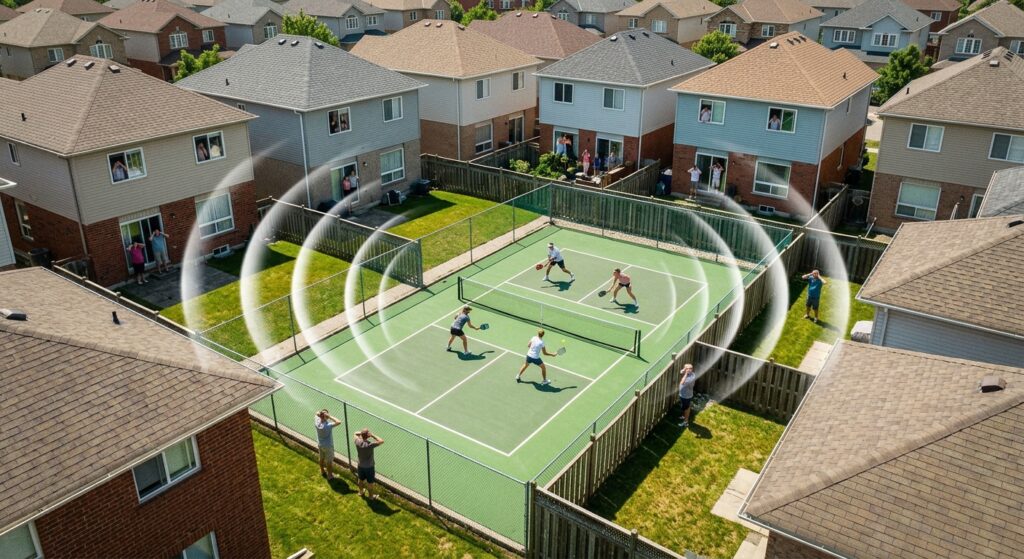
Pickleball’s rapid growth has intensified neighborhood conflicts over court noise, turning what were once minor complaints into legal disputes involving city councils, HOAs, and courts. The sport’s distinctive hollow sound carries farther and penetrates walls more effectively than other court sports, according to acoustical engineers.
The post-pandemic outdoor activity boom and shifting neighborhood dynamics have contributed to a broader rise in noise complaints across the country, spanning basketball courts, tennis facilities, and skateparks. Communities are increasingly divided between players asserting their right to public space and residents citing impacts on sleep, mental health, and property values.
It starts with a pop. Then another. Then another, in rapid, relentless succession, beginning at 7 a.m. on a Saturday when you were hoping to sleep in. By noon, the sound has become a kind of psychic assault — a hollow, percussive drilling that burrows through your walls, your pillow, your patience. You call the city. You file a complaint. Nothing happens. Two weeks later, you’re consulting a lawyer.
Welcome to one of America’s most surprising and increasingly bitter neighborhood conflicts: the war over court noise.
It’s not a new problem, exactly. Tennis courts have lived beside residential neighborhoods for decades, and the occasional noise complaint has always been part of the suburban social contract. But something changed in the last several years — something seismic. The explosive rise of pickleball, the transformation of parks and HOA communities, the post-pandemic outdoor-activity boom, and a general hardening of neighborhood relations have turned what was once a minor annoyance into full-blown legal warfare. Court noise complaints have gone from a trickle to a flood in municipal offices from Florida to Oregon, from New England to the Southwest.
People are angrier than ever. Communities that were once united by a love of outdoor sport are now divided into warring camps: the players who say they have every right to enjoy public space, and the residents who say the noise is destroying their quality of life, their sleep, their property values, and their mental health. City councils are being forced to pick sides. Homeowners associations are drafting emergency bylaws. Courts — the legal kind — are filling up with injunctions and noise nuisance claims.
And at the center of it all, increasingly, is the sport that nobody saw coming: pickleball. With its distinctive hollow “pop” from a perforated plastic ball meeting a solid paddle, pickleball generates a sound frequency that carries farther, penetrates walls more effectively, and grates on human nerves in ways that have been studied, quantified, and debated by acoustical engineers. Unlike the dull thud of a tennis ball or the low rumble of a basketball on pavement, the sharp, high-pitched crack of a pickleball paddle registers in a frequency range that the human auditory system finds particularly difficult to ignore or tune out — somewhere between 800 and 1,000 hertz, according to some researchers, a range that cuts through ambient noise with remarkable efficiency. It is, in the most literal sense, a sound designed by physics to be heard. But it’s not pickleball alone. Basketball courts, tennis facilities, skateparks, and even bocce courts have all generated noise disputes that ha